2021
Selim Furkan Tekin and Suleyman S. Kozat, Submitted to IEEE Transactions on Signal Processing (TSP)
Crime Prediction with Graph Neural Networks and Multivariate Normal Distributions
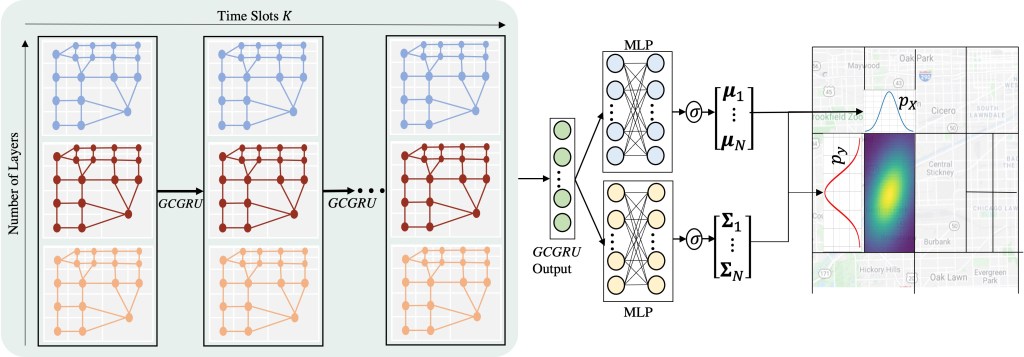
Existing approaches to the crime prediction problem are unsuccessful in expressing the details since they assign the probability values to large regions. This paper introduces a new architecture with the graph convolutional networks (GCN) and multivariate Gaussian distributions to perform high-resolution forecasting that applies to any spatiotemporal data. We tackle the sparsity problem in high resolution by leveraging the flexible structure of GCNs and providing a subdivision algorithm. We build our model with Graph Convolutional Gated Recurrent Units (Graph-ConvGRU) to learn spatial, temporal, and categorical relations. In each node of the graph, we learn a multivariate probability distribution from the extracted features of GCNs. We perform experiments on real-life and synthetic datasets, and our model obtains the best validation and the best test score among the baseline models with significant improvements. We show that our model is not only generative but also precise.
Selim Furkan Tekin, Oguzhan Karaahmetoglu, Fatih Ilhan, Ismail Balaban and Suleyman S. Kozat, Second Round Submission to Monthly Weather Review (MWR)
Spatio-temporal Weather Forecasting and Attention Mechanism on Convolutional LSTMs
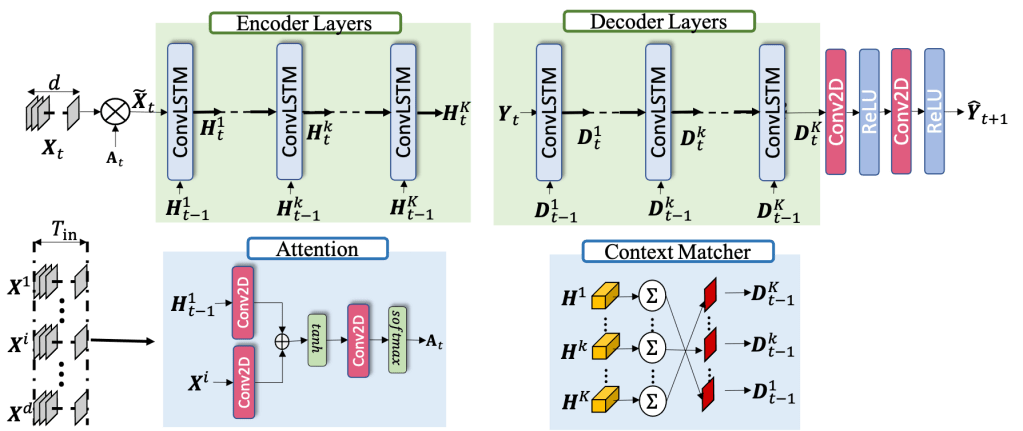
Numerical weather forecasting on high-resolution physical models consume hours of computations on supercomputers. Application of deep learning and machine learning methods in forecasting revealed new solutions in this area. In this paper, we forecast high-resolution numeric weather data using both input weather data and observations by providing a novel deep learning architecture. We formulate the problem as spatio-temporal prediction. Our model is composed of Convolutional Long-short Term Memory, and Convolutional Neural Network units with encoder-decoder structure. We enhance the short-long term performance and interpretability with an attention and a context matcher mechanism. We perform experiments on high-scale, real-life, benchmark numerical weather dataset, ERA5 hourly data on pressure levels, and forecast the temperature. The results show significant improvements in capturing both spatial and temporal correlations with attention matrices focusing on different parts of the input series. Our model obtains the best validation and the best test score among the baseline models, including ConvLSTM forecasting network and U-Net. We provide qualitative and quantitative results and show that our model forecasts 10 time steps with 3 hour frequency with an average of 2 degrees error. Our code and the data are publicly available.
 Selim Furkan Tekin